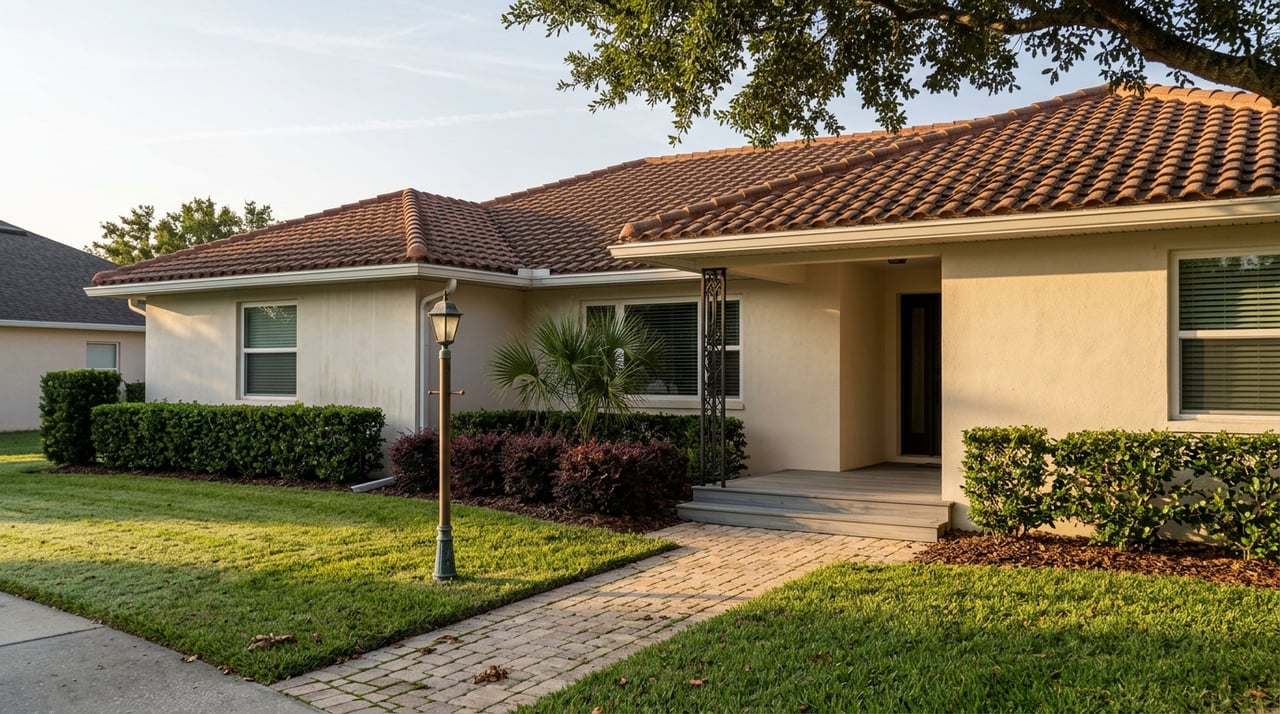
The Celebration Fee Line That Depends on Your Village, Not Your List Price
Why would two three-bedroom homes in Celebration, both priced in the mid $600,000s, carry Community Development District assessments that differ by more than $1,500 a year? The homes might be the same age. They might sit two streets apart. The answer has nothing to do with square footage, finishes, or how recently the roof was replaced. It comes down to which bond series financed the infrastructure under that particular street, and whether that bond has been paid off.
Most Celebration buyers compare list prices, then get surprised at the estoppel stage when the CDD line on one property looks nothing like the CDD line on another. That surprise is avoidable. The information is public. It just isn't where most people look.
Celebration runs on two separate cost structures that both show up before you sign anything. The Celebration Residential Owners Association, known as CROA, is the private homeowners association almost everyone means when they say "the Celebration HOA." Membership is automatic for residential owners, and dues fund the parks and common areas that define the town's daily feel: Lakeside Park, Founder's Park, Heritage Park, North Village Park, East Village Park, and the Artisan Park and Club.
Separately, the Celebration Community Development District, a special-purpose unit of local government created under Florida law, issues bonds to build and maintain roads, drainage, and streetlights, then bills property owners for both the debt and the upkeep through a non-ad valorem assessment on the annual Osceola County tax bill. CROA and the CDD are governed differently, budgeted differently, and billed differently, but a buyer sees both on the same closing disclosure.
Some online comparisons of Celebration to other master-planned communities skip this entirely and describe Celebration as an HOA-only town with no CDD. That's not what the district's own records show. The Celebration CDD publishes its finances, meeting minutes, and adopted budgets directly, and the assessment has existed since the community's earliest phases. If a source tells you Celebration has no CDD, ask for a citation. There isn't a current one.
The reason two similarly priced homes can carry different CDD bills is that the district didn't fund the whole town with one loan. It issued separate bond series as each phase was built, and each series has its own payoff schedule tied to specific villages.
| Bond Series | Villages Funded | Debt Service Retires |
|---|---|---|
| 1994 (refunded in 2005) | Celebration Village, Celebration Place, Lake Evalyn, West Village, part of North Village | May 2016 |
| 1997 | Remaining North Village, Celebration Boulevard | May 2018 |
| 2002 | East Village 1, Aquila Reserve, Roseville Corner | May 2022 |
| 2003 | South Village 2 (Artisan Park) | May 2034 |
Read that table as a map of who is still paying and who isn't. Owners in Celebration Village, Celebration Place, Lake Evalyn, West Village, and the older half of North Village have been debt-service-free since 2016. The rest of North Village followed in 2018. East Village 1 and Aquila Reserve caught up in 2022. Artisan Park, which most buyers experience as Celebration's newest and most amenity-rich product, has eight more years of active bond payments ahead of it.
That inverts the assumption a lot of buyers walk in with. Newer usually reads as more expensive to build and therefore more expensive to own going forward, which tracks for CROA sub-fees and condo dues. But on the CDD line specifically, older is often cheaper, because the infrastructure debt behind those original streets has already been retired. The maintenance and operations portion of the assessment never disappears entirely, since it funds ongoing upkeep every year, but the debt service component that makes up the bulk of a fresh CDD bill is gone in the town's original core and still active in its newest section.
CROA dues alone run roughly $280 to $490 a month depending on the property, and that's before anything CDD-related enters the picture. Artisan Park and Aquila Reserve carry additional sub-association fees on top of CROA, typically $60 to $150 a month more, which fund amenities specific to those villages rather than town-wide.
Condos add another layer entirely. Celebration doesn't run one town-wide condo fee. Buildings like Georgetown, Mirasol, and Siena each operate their own association with its own budget, so a condo buyer needs the documents for that specific building, not a general Celebration estimate.
Then there's the CDD assessment itself, which in the current fiscal year's adopted budget varies by parcel type and bond series enough that the total can land anywhere from roughly $1,300 to just over $3,000 per unit annually. A parcel still inside its debt service window pays meaningfully more than an otherwise identical parcel whose bond retired years ago.
Stack all of that together and you get a town where the list price tells you almost nothing about the ongoing cost of ownership. Two homes at the same price point, one in West Village and one in Artisan Park, can carry a total annual fee difference in the thousands once CROA, sub-HOA, and CDD debt service are added up.
None of this makes Artisan Park a worse purchase. Buyers choose it for the clubhouse, the larger homes, and the newer product, and that's a legitimate trade-off to make with eyes open. The problem isn't the fee. It's the assumption that comparing two Celebration listings by price alone gives you an apples-to-apples read on carrying cost. It doesn't, and the gap isn't small enough to round away.
The fix is straightforward. Before writing an offer, ask for the parcel's current CDD assessment breakdown, which the district's finance office can confirm, along with whatever CROA and sub-association documents apply to that specific address. The Celebration CDD's own finance page links directly to adopted budgets and audit reports, and a certified estoppel will show exactly where a given parcel sits on its bond schedule. That's a five-minute request that prevents a five-figure surprise over the life of ownership.
If you're comparing Celebration villages against each other, or against communities elsewhere in Central Florida, this is exactly the kind of detail worth running past someone who works this market regularly rather than piecing together from listing descriptions. Our team put together a broader look at what daily life differs from village to village in our guide to Celebration's villages and everyday lifestyle, and it pairs well with the fee picture here.
Does paying off my CDD bond early lower my annual assessment? Paying off the debt service portion removes that piece of the bill going forward, but the operations and maintenance assessment continues for as long as the district exists, since it funds annual upkeep rather than a fixed loan.
If I buy in a village whose bond already retired, am I done paying CDD fees forever? No. You'll still see the O&M portion on your tax bill every year. What you avoid is the debt service portion, which is typically the larger of the two components.
Do all Celebration properties carry both CROA and CDD fees? Nearly every residential parcel carries CROA dues, since membership is tied to ownership under the community's governing documents. CDD assessments apply based on which bond series funded that parcel's phase, and the O&M portion applies broadly across the district regardless of debt status.
Is the CDD assessment the same as my HOA fee? No. CROA is a private association billed on its own schedule. The CDD assessment is a government non-ad valorem charge that appears on the Osceola County property tax bill. They're separate line items funding separate things.
If you're weighing a purchase in Celebration and want the real carrying cost for a specific village or parcel before you write an offer, Keith Renner and the team at Nectar Real Estate can pull the current CDD and CROA documents for any address you're considering. Start with a personalized home valuation and we'll walk the full fee picture with you, village by village.
Expertise isn’t just about knowing the market—it’s about dedication to every client’s unique goals. At Nectar Real Estate, we pride ourselves on our ability to combine deep local knowledge with an unwavering commitment to providing exceptional service.